
Los hórreos
Painting the cultural heritage of northern Spain
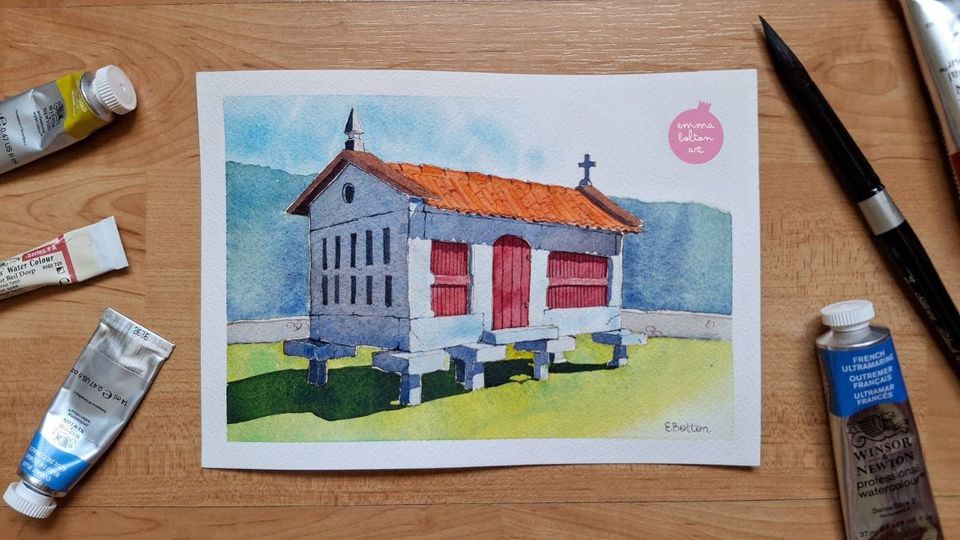
If you find yourself travelling around the north of Spain, keep an eye out for los hórreos. These stone and wooden structures have been used for storing crops and food in the region for hundreds of years, and in April 2026 were declared to be part of the region's intangible cultural heritage. The hórreos probably originate from Ancient Roman horrea (warehouses), although the structures had to be significantly adapted to reflect the different environment and crops of northern Spain.
You'll recognise the hórreos by the distinctive pillars or pies that the structures sit on to create good ventilation. At the base of each leg sits a tornaformiga, a little moat dug into a horizontally-laid stone that's filled with water to prevent ants climbing up the pillars. And at the top of each pillar sits another horizontal stone known as a tornarrato, which prevents rodents and other animals from accessing the grain.
The hórreos are part of the "collective memory" of communities in Galicia, the Asturias, León, Cantabria, Navarra and the Basque country – you'll find them mentioned in songs and folktales. Unfortunately, many of the hórreos are now at risk because of a lack of documentation detailing the restoration and maintenance of these structures, as well as a shortage of tradespeople trained in these traditional techniques.
The hope is that formally recognising the value of these structures will support conservation efforts that are already underway and encourage new ones. For example, there's a quesería (or cheese shop) in the Asturias that matures their Afuega'l pitu cheese in a 500-year old hórreo because of the unique fungi the old wooden structure contains.
The hórreos come in all different materials, sizes and shapes: square, round and even l-shaped. You'll find the oldest conserved hórreo in Boñar in León. It was constructed in the 16th century using wood without any nails. And the tallest hórreo in Galicia has three floors that reach 8.5 metres high and no pillars. (If you're travelling in Galicia, check out Hórreos de Galicia, a list of hórreos that's been lovingly catalogued by a postal worker and amateur photographer from Santiago in their free time over the last fifteen years.)
It was such a pleasure to paint this Galician hórreo for a recent commission and learn more about what makes these structures so special. The regions of northern Spain feel so different to where I live in the south, despite the country's compact size. These regions have distinct languages, traditions, weather and landscapes (including from each other). Even the colours are different to Andalucía, and I had a lot of fun experimenting with a new colour palette in this painting.
Sketches from Granada celebrates every-day moments of connection with strangers, friends and ourselves. I know how easy it is not to be present in your own life, and I hope these sketches inspire you to seek out those moments that are worth savouring.
If this post resonated with you, please share it with a friend you think might appreciate it too!
Celebrating moments of connection with strangers, friends and ourselves

Member discussion