How do you keep track of what you read?
When the process is the point

This is the start of a new and occasional series where I reflect on your questions. If you'd like to ask a question, comment on this post or send an email to info@emmabolton.com. (I can't promise I'll answer, but I will if I have something substantive to add to the conversation or can point you towards a useful resource.)
Some of the topics that would be a good fit for this are sketching techniques or my art practice, life in Spain, learning a language as an adult, self-care or books. (Your privacy is important to me, so I'll anonymise the questions unless you tell me otherwise.)
And if you enjoy these kinds of deep dives, consider upgrading your subscription or sending me a tip.
One of the things I celebrated in my 2025 year in review was that I stopped trying to track everything in my life. For the first time in a decade, I didn't set a reading goal related to finishing a certain number of books. Instead, I let myself explore new authors, reread books and borrow from the library based on what felt right in the moment. I received this question from one of you in response:
I'll share how I'm currently tracking my reading at the end of this post, but first I want to share a process to help you work out what tools will work best for you. Taking time to understand my motivations and needs before committing to a new system helps me to be more present and choose tools that are consistent with my values. I hope working through the following questions does the same for you.
Grab a pen and a notebook, set a timer for five minutes and brainstorm your response. Some reasons might be that you want to:
This makes it easier to recommend books to friends, buy gifts and know what book you're up to in a longer series. (This is our questioner's goal and we'll use it as the example going forward).
Maybe you've discovered a love of romantic fantasy but all of your in-real-life friends prefer non-fiction. It can be fun to connect with other readers who'll gush about the same characters as you.
Maybe you used to read voraciously when you were a student, but now you find yourself scrolling social media while a YouTube video plays in the background. (This is a genuine reason and if this is you, set an annual or monthly reading goal if it helps you follow through on your intention.)
If you want to read more in general, maybe pick a number of pages you want to read per month or a number of days per week you want to pick up a book - something that you can easily measure and adjust. Picking a number of books to read can create weird incentives - eg you pick the shortest books you can find, rather than the ones you want to read the most (which might have more pages or take you longer to read because you're less familiar with the genre). Remember also that audio books, reading fan fiction, etc all count as reading.
One of the reasons I didn't set a reading goal in 2025 was because I wanted to read novels in Spanish, and it takes me much longer to read a book in Spanish than in English. My challenge is not to spend more time reading – it's often to put down the book and engage with the real world! (When I was working part-time while I was at Uni, I used to literally walk from the bus stop to my office with my nose in a book. I was a walking hazard well before any of us had a smart phone.)
(This is me.) Writing helps me think and process my thoughts and emotions. If a book really resonates with me, I'm getting out a notebook and writing down my initial impressions of what I just read. (Some of these drafts are later tidied up to become posts on this blog, but it's never why I initially put pen to paper).
I've noticed that when I read on an e-reader, I tend to read more quickly and skim more. So I've started buying and borrowing physical books again, after years of moving countries where it was much easier to read on an e-reader.
It gives me joy to dog-ear pages and mark passages that resonate with a pencil. There is so much sensory pleasure in the physical weight of a book, the smell of paper, the act of turning to the next page. I want to read with my whole body.
Making reading physical again helps me to read more deeply and remember why certain stories felt so powerful in the moment. It's also why I've been rereading a lot of books lately – it's interesting to see over time which books continue to move me, and which were essential (but only for a moment in time).
All of these reasons are valid! I think it's worth knowing which bucket you fit in so you can choose the right tool for the job.
Now that you know your why, brainstorm what features are non-negotiable in the tool you use to track your reading, versus what's nice to have. For example:
Since our questioner wants to track their reading to recommend books to their friends, they'll want a list that's easily searchable, and some sort of ranking system so they can easily identify their favourite reads.
Here are some options for tracking your reading:
An electronic tool will probably suit our questioner's needs best (since I know they read a lot). For the reasons I'll explain below, I'd recommend they export their list of books from Goodreads. They could then save that spreadsheet locally and manually add to it over time or, if they like seeing their book covers, import their books into Pagebound.
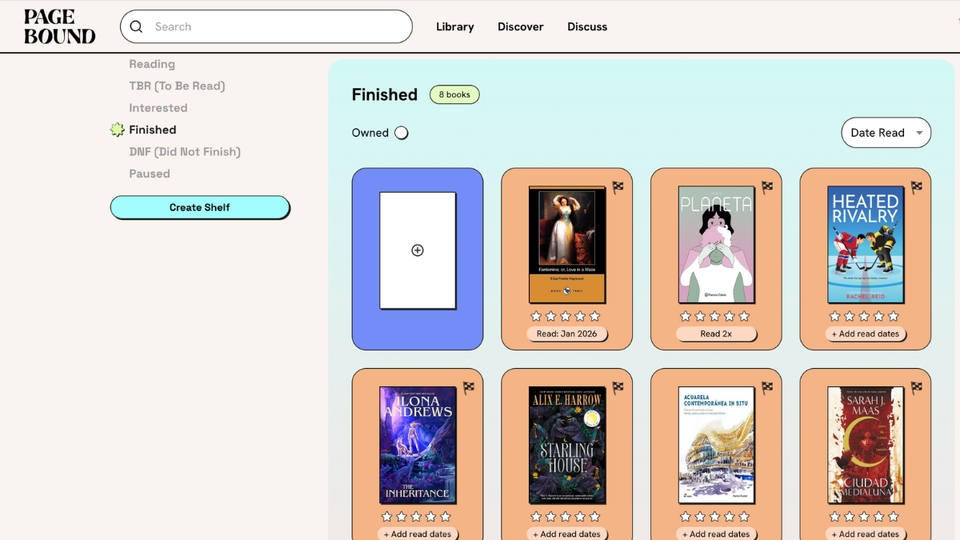
If you decide to use an online platform to track your reading, I've been enjoying using Pagebound. If you're a visual person, Pagebound has a simple (and pretty) tile format for book covers, and you can easily sort your books by date read or by title. (If you want to add a reading goal or ratings to the books you read, you can do that too.)
Pagebound is also a great option if you want to build community but get away from the performance of reading that can happen on a platform like Goodreads. Pagebound encourages you to be anonymous and doesn't share follower counts publicly. They don't have book recommendations or any other features that use generative AI. I also like that Pagebound is self-funded and co-run by two women – one of them is a software engineer and the other studied creative writing.
The flip side is that, if you can, I'd recommend getting off Goodreads or StoryGraph. Goodreads has been owned by Amazon since 2013, and it's not hard to believe that it's "mainly interested in Goodreads as a source of user-generated data and has little motivation to improve it." The platform also has a history of allowing one-star reviews of books prior to their release, and failing to protect queer authors and authors of colour from harassment. And, unfortunately, StoryGraph is now using generative AI to create inaccurate summaries of author's books, which they put above the author's own book description.
Reading, like art, is an inherently political act. The choices we make matter and can make a difference, particularly if we act in solidarity with one another.
While I'm no longer setting a goal for how many books I want to read, I do read a lot and like to keep track of what I've read. I use different tools for different purposes:
While I have a spreadsheet saved with all the books I've added to Goodreads since I started my account in 2011, I decided not to import it into Pagebound. There are books I gave four or five stars to on that list that I would never recommend to someone now, because they don't resonate with who I've become. My reading goals have also changed, and I've been enjoying starting with a clean slate (and without any starred reviews).
Do you track your reading? Why (or why not)?
What are your favourite tools for doing so?
Sketches from Granada celebrates every-day moments of connection with strangers, friends and ourselves. I know how easy it is not to be present in your own life, and I hope these posts inspire you to seek out those moments that are worth savouring.
If this post resonated with you, please share it with a friend you think might appreciate it too!
Become a subscriber to receive my newsletters directly in your inbox.



Member discussion